James A. Hessler by unknow
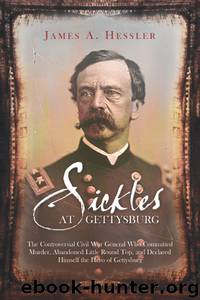
Author:unknow
Language: eng
Format: mobi
Tags: Generals, Bisac Code 1: HIS036053, Gettysburg, General, United States, 1863, Biography, Military, Biography & Autobiography, Battle Of, Civil War Period (1850-1877), Pa., History
ISBN: 9781611210453
Publisher: Savas Beatie
Published: 2010-04-19T05:00:00+00:00
A Matthew Brady photo of Major General Sickles, taken circa 1864-1865. Library of Congress
Chapter 15
My Only Motive is to Vindicate History
THE BATTLE OF GETTYSBURG – IMPORTANT COMMUNICATION FROM AN EYE-WITNESS–HOW THE VICTORY WAS WON AND HOW ITS ADVANTAGES WERE LOST – GENERALS HALLECK’S AND MEADE’S OFFICIAL REPORTS REFUTED, ETC.
To the Editor of the Herald:
The battle of Gettysburg is the decisive battle of this war. It not only saved the North from invasion, but turned the tide of victory in our favor. The opinion of Europe on the failure of the rebellion dates from this great conflict. How essential, then, that its real history should be known. Up to this moment no clear narrative has appeared. The sketches of the press, the reports of Generals Halleck and Meade, and the oration of Mr. Everett, give only phases of this terrible struggle, and that not very correctly. To supply this hiatus, I send you a connected, and, I hope, lucid review of its main features. I have not ventured to touch on the thrilling incidents and affecting details of such a strife, but have confined myself to a succinct relation of its principal events and the actors therein. My only motive is to vindicate history, do honor to the fallen, and justice to the survivors when unfairly impeached.1
The author of this letter, who dubbed himself “Historicus,” provided the Herald’s readers with a point-by-point duplication of Sickles’ testimony. According to Historicus, on July 1 Sickles had assumed “the grave responsibility of moving to” the relief of the First and Eleventh corps “without orders.” Historicus “saw several copies” of Meade’s Pipe Creek Circular “stating that his [Meade’s] advance had accomplished all the objects contemplated, namely, the relief of Harrisburg and Philadelphia, and that he would now desist altogether from the offensive.” Historicus found it “strange that General Meade should make no mention in his report of this singular and most important fact,” that he issued a plan “directing his whole army to retire and take up the defensive on Pipe Creek.”2
As the narrative progressed to July 2, and quoting from General Lee’s battle report, Historicus noted that General Longstreet was ordered to carry a Federal “position from which, if he could be driven, it was thought our army could be used to advantage in assailing the more elevated ground beyond.” To Historicus, it was “plain enough that Lee regarded the point where our left was posted as the key to our position.… It is not to be supposed that General Meade refused to see this; but as he makes no mention of it in his report, I propose, for the sake of the future historian of the battle, to tell what I know about it.”3 He continued:
Near this important ground was posted the valiant Third Corps, and its commander, General Sickles, saw at once how necessary it was to occupy the elevated ground in his front toward the Emmitsburg road, and to extend his lines to the commanding eminence known as the Round Top, or Sugar Loaf hill.
Download
This site does not store any files on its server. We only index and link to content provided by other sites. Please contact the content providers to delete copyright contents if any and email us, we'll remove relevant links or contents immediately.
Crystal Cove by Lisa Kleypas(39188)
Spell It Out by David Crystal(36149)
For the Love of Europe by Rick Steves(14566)
Underground: A Human History of the Worlds Beneath Our Feet by Will Hunt(12144)
Tools of Titans by Timothy Ferriss(8490)
Giovanni's Room by James Baldwin(7432)
The Rosie Project by Graeme Simsion(6520)
Beach Read by Emily Henry(5517)
A Year in the Merde by Stephen Clarke(5471)
Perfect Rhythm by Jae(5460)
Spare by Prince Harry The Duke of Sussex(5253)
The Body: A Guide for Occupants by Bill Bryson(5176)
Endurance: Shackleton's Incredible Voyage by Alfred Lansing(4845)
China Rich Girlfriend by Kwan Kevin(4609)
The Silk Roads by Peter Frankopan(4586)
Machine Learning at Scale with H2O by Gregory Keys | David Whiting(4361)
A Game of Thrones 1 by George R R Martin(4217)
The Motorcycle Diaries by Ernesto Che Guevara(4151)
Alive: The Story of the Andes Survivors by Piers Paul Read(4077)
